When Do You Actually Need Async Processing in Spring Boot?
A practical guide to when async processing helps in Spring Boot, when it only adds complexity, and how to think about @Async, queues, and reactive approaches.
Korean version: Spring Boot에서 비동기 처리는 언제 필요할까? 꼭 써야 하는 경우와 아닌 경우
This is part 4 of the Spring/WebFlux series, following Spring MVC vs WebFlux, Blocking vs Non-Blocking, and Mono vs Flux. Here the focus shifts from terminology to a practical engineering question: when is async processing actually worth the trouble?
At some point, most Spring Boot developers start asking the same questions:
- Will async processing make my service faster?
- Should every API become asynchronous?
- When should I use
@Async, a queue, or WebFlux? - When is synchronous code still the better choice?
Because words like async, reactive, and non-blocking are everywhere, it is easy to get the wrong impression that “more asynchronous” automatically means “better architecture.”
In practice, that is not how it works.
Async processing is powerful when it solves a real waiting or workflow problem. If you introduce it without a clear need, you often get more complexity than value.
Quick summary
The practical decision points are these:
- For ordinary CRUD applications, synchronous processing is often enough.
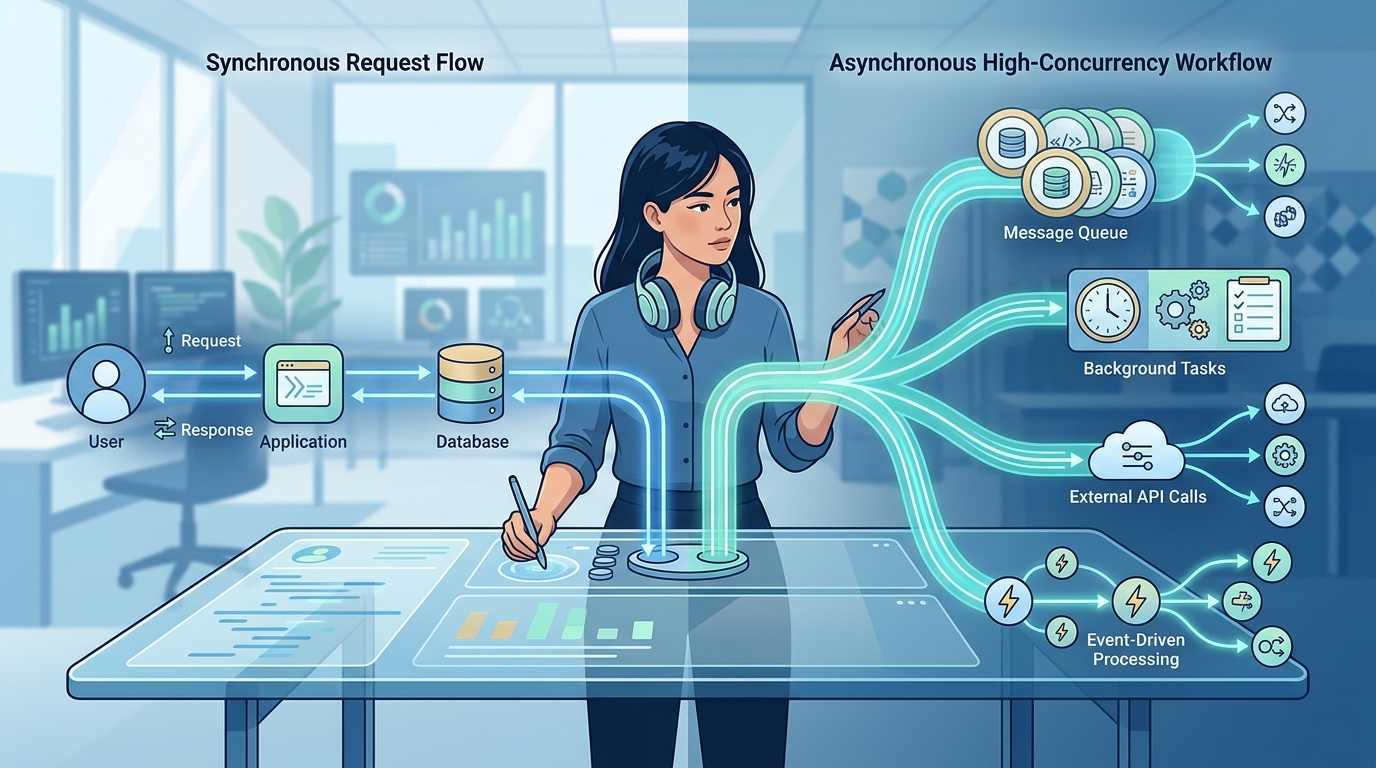
- Async becomes useful when response work and follow-up work should be separated.
- It also matters when external waiting is long or background jobs are naturally better than request-time work.
- Making everything async is rarely a good design goal by itself.
- Before changing architecture, check where the real bottleneck is.
Why async exists in the first place
Async processing is not there to make code look advanced. It exists because some work does not fit neatly into a single request-response cycle.
Typical examples:
- sending an email after signup
- pushing notifications after an order completes
- generating thumbnails after file upload
- producing a report that takes a long time
- calling slow external systems
- handling real-time or streaming workflows
These cases usually have one thing in common:
the user does not always need to wait for every downstream step to finish before getting a response.
Do normal CRUD services need async?
Very often, no.
For many admin systems, internal tools, content systems, and ordinary business APIs, a synchronous flow is still the most practical choice.
Why?
- the request flow is clear
- debugging is easier
- error handling is more straightforward
- the team can move faster with familiar patterns
For a simple endpoint like this:
1
2
3
4
@GetMapping("/orders/{id}")
public OrderResponse getOrder(@PathVariable Long id) {
    return orderService.findById(id);
}
there is usually no benefit in forcing async behavior just because it sounds modern.
If the system is not struggling, added complexity is usually a net loss.
When async processing really makes sense
This is where async becomes valuable.
1. When the response and the follow-up work should be separated
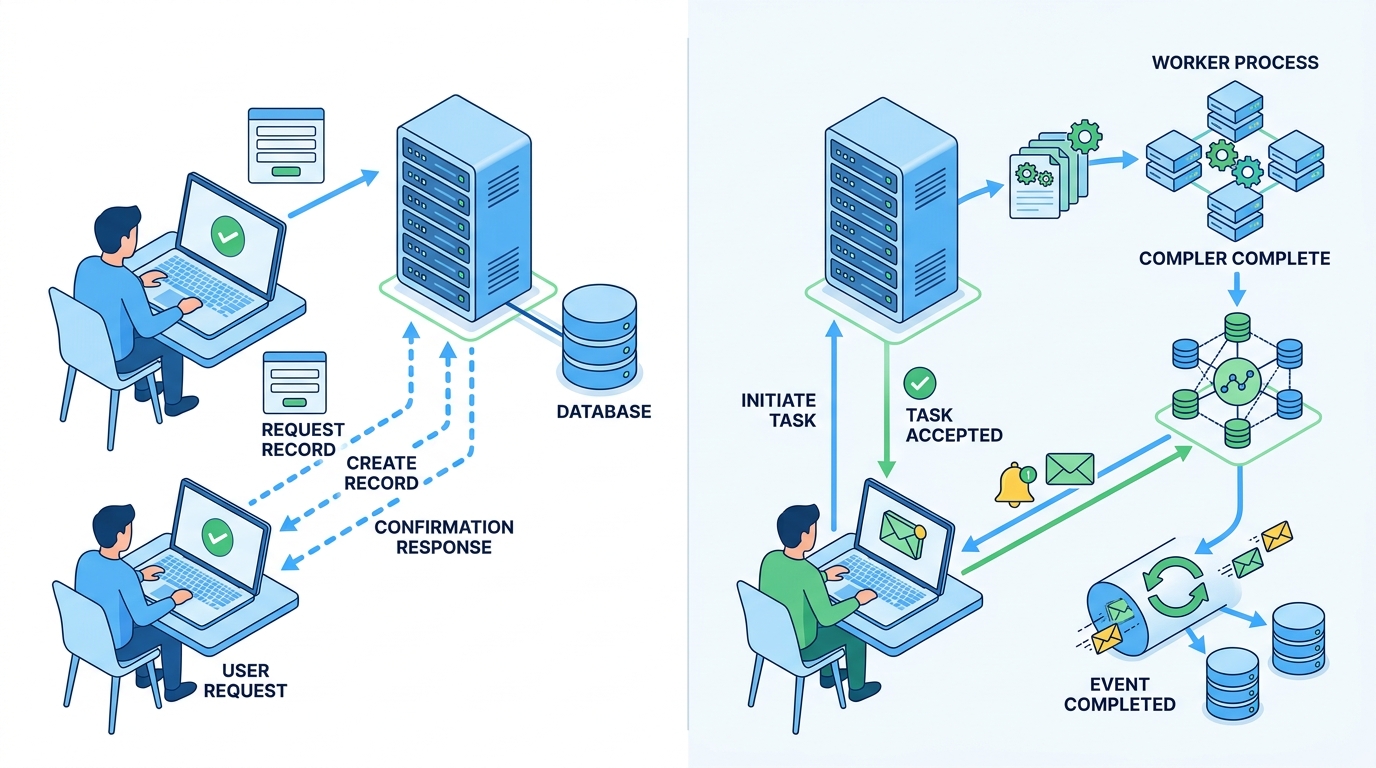
Sometimes the client only needs confirmation that the request was accepted.
The expensive work can happen afterward.
Examples:
- signup completes, then a welcome email is sent
- order is placed, then notifications are pushed
- a file is uploaded, then thumbnails are generated
- a report request is accepted, then report generation runs in the background
This is one of the most practical places to use async patterns.
2. When external API waiting dominates response time
Some services do not spend much time computing, but they spend a lot of time waiting:
- payment gateways
- identity providers
- shipping APIs
- partner systems
If those waits are long and frequent, async or non-blocking design becomes more attractive—especially under high concurrency.
3. When the work naturally belongs in the background
Some tasks simply do not belong inside a normal request cycle:
- large file processing
- video encoding
- bulk data aggregation
- PDF generation
- AI inference pipelines
For work like this, the better user flow is often:
- request accepted
- job started
- status tracked separately
- result retrieved later or delivered by notification
That is not just a performance choice. It is often a better product experience too.
4. When concurrency or streaming is a core requirement
For live notifications, SSE, chat, event streams, or large numbers of concurrent long-lived connections, the conversation moves beyond “should I use @Async?”
At that point, a more reactive model such as WebFlux may make more sense.
When async is probably unnecessary
It is just as important to know when not to introduce async.
1. When there is no confirmed bottleneck yet
“Traffic might grow later” is not a strong enough reason by itself.
Building complexity ahead of real need often backfires.
2. When the team is not ready for the operational cost
Async design is not just about code. It raises operational questions too:
- how are failures retried?
- how are stuck jobs found?
- how do logs and traces follow the work?
- what happens if downstream systems are temporarily unavailable?
Those are real responsibilities, not side notes.
3. When most requests are short and simple
If the majority of endpoints are small CRUD actions with quick response times, synchronous flow may still be the best trade-off.
4. When debuggability matters more than architectural sophistication
Simple request-response code is often easier to trace during incidents. That matters a lot in production.
Async options in Spring Boot are not all the same
When people say “async in Spring Boot,” they may mean very different things.
@Async
This is often the simplest starting point when you want to separate a follow-up action from the main response.
It can be a reasonable fit for things like email sending or lightweight post-processing.
Message queues
If you need stronger durability, retry behavior, or better decoupling, queue-based patterns with tools like Kafka or RabbitMQ are often more appropriate.
WebFlux
If the real issue is high-concurrency I/O or streaming, then the conversation is no longer just about background jobs. It becomes a broader reactive architecture discussion.
That is a much bigger change than just adding @Async.
A practical checklist
Async is worth evaluating if most of these are true:
- response work and follow-up work should be separated
- external waiting contributes heavily to latency
- long-running work should move to the background
- concurrency or streaming is a meaningful requirement
- the team is prepared to operate retries, timeouts, and monitoring properly
Synchronous design is still probably better if most of these are true:
- the service is mostly CRUD
- there is no measured bottleneck yet
- code clarity and maintenance matter more than specialized concurrency handling
- the team has limited async operational experience
One-sentence takeaway
Async processing is not something you add because it sounds better. You add it when waiting, background work, or concurrency patterns make synchronous flow the wrong shape for the problem.
Final thoughts
Spring Boot gives you several ways to introduce async behavior, but the right question is never “How do I make everything asynchronous?”
The better question is:
Which parts of this workflow actually benefit from being decoupled from the request-response path?
That usually leads to better decisions.
A practical summary looks like this:
- ordinary CRUD often does not need async
- background follow-up work often does
- long waits and streaming push you toward more async-friendly models
- operational complexity has to be part of the decision
The next post takes that same practical lens into data access with JPA vs R2DBC in Spring.
Spring/WebFlux series
- Spring MVC vs WebFlux: When Should You Use Each?
- Blocking vs Non-Blocking in Backend Systems: What Actually Matters?
- Mono vs Flux in Spring WebFlux: The Core Idea in Plain English
- When Do You Actually Need Async Processing in Spring Boot?
- JPA vs R2DBC in Spring: Which One Fits Your Application?
- WebFlux in Production: Pitfalls to Watch Before You Adopt It